
For many CMOs, one of the biggest challenges in paid media campaigns is not just what to say—it’s how to organize the message. When campaigns are scattered, inconsistent, or misaligned with broader business goals, results suffer. But when everything clicks? Paid media becomes a strategic amplifier for your brand’s narrative.
This post breaks down a simple yet powerful framework for organizing your messaging across channels, ensuring every dollar spent on ads supports the brand’s larger objectives.
Let’s dive in.
Why You Need a Messaging Framework (Even If They Sometimes Oversimplify)
Let’s be honest: most CMOs have a love-hate relationship with frameworks. They can feel too rigid, too one-size-fits-all. But when you’re managing multiple campaigns across channels—each with different audience intents and engagement styles—a framework gives you the clarity to scale without chaos.
Think of this framework not as a rulebook, but as a compass. It gives your team a shared language and direction, without limiting creativity or agility.
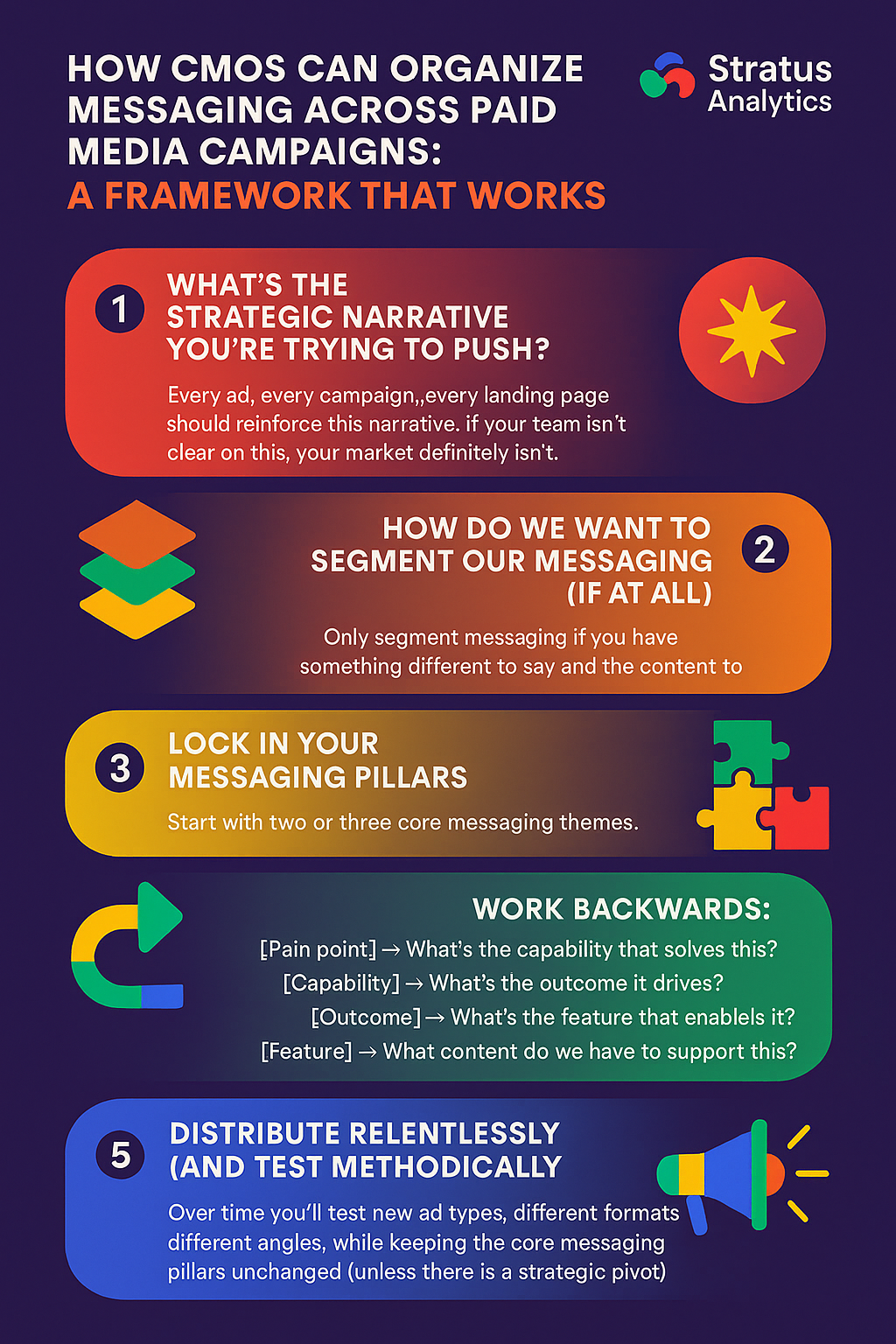
Step 1: Define Your Strategic Narrative—This Is Your North Star 🌟
Before you write a single ad, you need to know: What’s the strategic narrative we’re trying to push into the market?
This is the foundation for everything else. Your strategic narrative isn’t just your brand tagline or mission statement—it’s your brand’s point of view on the market. It’s the story you’re telling about what’s broken, what’s possible, and why your solution is different.
Every ad, every landing page, and every touchpoint should reinforce this narrative. If your internal team can’t clearly articulate this story, you can bet your market is even more confused.
Ask yourself:
- What does our product or service really solve?
- What shift in thinking do we want our audience to make?
- What’s the “aha moment” we want them to walk away with?
This narrative should be consistent across campaigns, even if you tailor specific messages to different audiences or channels. It’s the thread that ties it all together.
Step 2: Decide Whether—and How—to Segment Your Messaging
Next comes a critical decision: Should we segment our messaging? And if so, how?
Segmentation is often treated as a default: “We need separate messaging for SMBs, mid-market, and enterprise,” or “We need different creative for buyers vs. users.”
But here’s the catch—don’t segment for the sake of it.
Only create segmented messaging if you have something different to say to that audience—and the content to support it. Otherwise, you’re just creating extra work and watering down your focus.
Sometimes, a strong, evergreen message can work better across all audiences—especially in earlier stages of awareness where you’re still introducing your narrative.
Smart segmentation looks like:
- Different pain points for different buyer types
- Varying language or formality levels by company size
- Unique business outcomes valued by different verticals
But avoid segmentation when:
- You’re saying the same thing in slightly different words
- You don’t have enough creative budget or resources to support it
- Your product solves the same problem for everyone
Start broad. Narrow only when there’s strategic value in doing so.
Step 3: Lock In Your Messaging Pillars
Once your narrative and segmentation strategy are locked in, it’s time to define your messaging pillars—the core themes you’ll build campaigns around.
Think of messaging pillars as the scaffolding for your paid media efforts. Each one should map to a high-impact pain point your customers face.
You’ll want 2–3 strong pillars, max. Any more, and you risk fragmentation.
To develop them:
- Dig into sales call transcripts. What challenges come up over and over?
- Talk to customer success and support. What are people struggling with?
- Interview happy customers. What was the tipping point that made them buy?
From that insight, choose the top pain points your product is uniquely positioned to solve. Then turn those into pillars that serve as the backbone of your campaigns.
Example messaging pillars might include:
- Efficiency (for a tool that saves time)
- Compliance (for software in regulated industries)
- Scalability (for a platform that grows with your business)
These themes should show up across your landing pages, ad copy, explainer videos, and even organic content. Consistency = memorability.
Step 4: Work Backwards from Pain Point to Message
Now that you have your pillars, it’s time to operationalize them. Here’s a practical way to turn each pillar into campaign-ready messaging:
- [Pain Point] → What’s the capability that solves this?
This is your hook. What can your product do that makes this pain go away? - [Capability] → What’s the outcome it drives?
Move from feature to impact. This is how you make it matter to the buyer. - [Outcome] → What’s the feature that enables it?
Don’t lead with features—but be ready to support your claims with substance. - [Feature] → What content do we have to support this?
This is where your marketing library comes in. Find or create assets that bring this message to life—customer stories, case studies, short-form videos, and more.
For example:
- Pain Point: “We waste too much time managing spreadsheets.”
- Capability: “Automated dashboarding.”
- Outcome: “Save 10+ hours per week on reporting.”
- Feature: “Real-time data integrations.”
- Supporting Content: A 60-second demo + case study with quantified ROI.
Each ad campaign can draw from this logic chain, and you can reuse this structure across formats: video ads, carousels, native, programmatic—you name it.
Step 5: Distribute Relentlessly (and Test Methodically)
Once the messaging is built, your job becomes distribution and iteration. Get that story into the market. Loudly. Consistently. Repeatedly.
But don’t confuse consistency with stagnation.
The core message—the narrative and pillars—should stay relatively stable. But the way you communicate it should be flexible. That’s where testing different formats and creative approaches comes in.
Test across:
- Visual styles and ad formats
- Emotional vs. logical framing
- Use of social proof vs. value props
- Short vs. long copy
What you’re looking for is resonance. Are people clicking? Are they converting? Are they remembering you?
Track results not just by CTR or impressions—but by how well your campaigns drive qualified traffic, pipeline creation, and eventually, revenue. That’s how you know your messaging is landing.
Final Thoughts: Messaging Is a Long Game, But a High-Leverage One
As a CMO, messaging can feel like a never-ending task. But when you align your team around a clear narrative, segment only when it’s strategic, anchor to a few solid messaging pillars, and execute with consistency and creativity—everything gets easier.
Media buying becomes smarter. Creative reviews are faster. Landing pages convert better. Sales conversations become smoother.
Great messaging is the hidden multiplier in your marketing strategy.
So use this framework as your guide—but evolve it as your company grows, the market shifts, and your customers teach you new things.

Hi there! I’m Scott, and I am the principal consultant and thought leader behind Stratus Analytics. I have a Master of Science degree in marketing analytics, and I’ve have been providing freelance digital marketing services for over 20 years. Additionally, I have written several books on marketing which you can find here on Amazon or this website.
DISCLAIMER: Due to my work in the packaging industry, I cannot take on freelance clients within the packaging manufacturing space. I do not want to provide disservice to your vision or my employer. Thank you for understanding.