When a Linkedin campaign performance is poor, most marketers will look at the high-level metrics—CTR, CPL, impressions—and assume something fundamental is broken. But sometimes, the best-performing segments are buried under the averages. And if you don’t peel back the layers of your audience data, you’ll never know they’re there.
Recently, I ran into this exact scenario while analyzing a LinkedIn campaign performance for a B2B client. At first glance, performance looked mediocre at best. But once I started breaking down the audience by specific criteria—company size, job seniority, existing vs. new customer status—I discovered a golden segment with a 280% higher win rate than the rest.
That insight completely shifted our strategy. Here’s how.
Why High-Level Campaign Metrics Can Be Misleading
When you’re working with paid media platforms, the dashboard metrics are designed to summarize performance. But summary stats can often hide the variability that truly matters.
For instance, if your CPL is $150 on average, it might mask that:
- One audience segment is converting at $80
- Another is converting at $300
Without deeper segmentation, you may kill or scale campaigns based on averages that don’t reflect the nuances in performance.
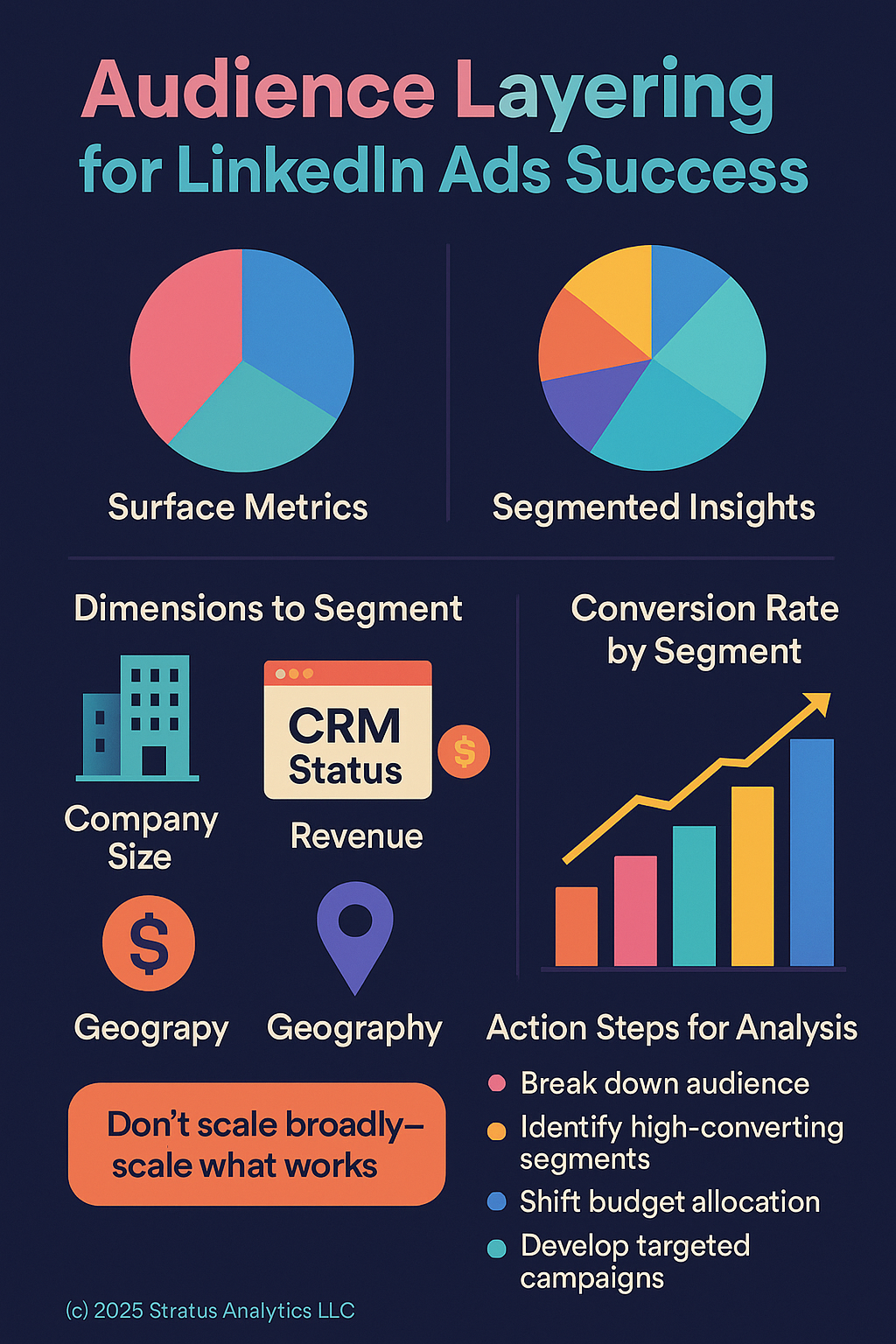
This is especially true for LinkedIn Ads, where targeting by company size, industry, and job seniority opens up an immense range of micro-audiences. The more refined your segmentation, the clearer your picture of where the actual business value lies.
The Breakdown: How I Found the 280% Lift in LinkedIn Campaign Performance
In my client’s campaign, we were initially targeting a fairly broad audience: multiple industries, a wide range of company sizes, and both current customers and prospects. Top-line metrics showed poor engagement and a high cost per opportunity.
So I rolled up my sleeves and did what I always recommend: layered segmentation.
Here’s what I did:
- Split by Company Size
I broke the data into brackets: 1–50, 51–200, 201–500, 501–1,000, and 1,000+. Some of these groups weren’t converting at all. Others were surprisingly strong. - Segmented by Relationship Status
Using CRM data, I labeled users as new prospects vs. existing customers. This revealed drastically different conversion patterns—particularly with mid-sized companies we already had in our database. - Cross-Segment Analysis
When I overlaid company size and customer type, one audience stood out: existing customers from 201–500 employee companies who were being served LinkedIn Ads. Their win rate was 280% higher than the baseline. This group was previously getting lumped in with all prospects, and we were missing the forest for the trees.
What Happened Next? We Doubled Down
Once that insight surfaced, the decision was obvious: we restructured the campaign to isolate and prioritize this segment.
- We increased budget allocation to this audience
- Built personalized creative that acknowledged their current relationship with the brand
- And launched new campaigns focused on cross-sell/upsell rather than net-new acquisition
The results? ROI improved significantly within 30 days, and we were no longer wasting budget on segments that weren’t converting.
Why Most Ad Platforms Fall Short on Insight
LinkedIn, like most ad platforms, does a good job giving surface-level insights. But the more strategic layers—like purchase history, CRM status, or funnel stage—usually don’t exist natively.
To really analyze campaigns at this level, you need to:
- Export the data
- Merge it with CRM or offline conversion data
- Perform layered segmentation (pivot tables, data modeling, or even SQL if needed)
If you stop at what’s in the ad platform, you’ll never see the full picture.
Strategic Takeaways
So what does this mean for your marketing strategy and your Linkedin campaign performance? Here are a few principles you can apply immediately:
1. Don’t Accept the Averages
Always look beneath the surface. Average CTR or CPL can hide extremes that offer much better targeting opportunities.
2. Marry CRM + Ad Data
Your ad platform doesn’t know your customers. Syncing CRM data to platforms like LinkedIn unlocks strategic segmentation—especially for upsells and retention campaigns.
3. Segment More Than You Think
Don’t just segment by job title or industry. Include company size, revenue, relationship status, funnel stage, geography, and more. The best opportunities often exist at the intersection of multiple dimensions.
4. Reassess and Restructure
Once you find a high-performing segment, give it the attention it deserves. Rewrite copy, shift budgets, and experiment with offers tailored to that group.
5. Use Your Data, Don’t Just Collect It
You probably already have enough data. The key is using it to surface new insights—not just reporting performance but reshaping strategy.
Final Thoughts
Data doesn’t give up its secrets easily. But with thoughtful segmentation and analysis, you can uncover opportunities that completely reshape campaign outcomes.
If you’re only looking at surface metrics, you’re likely making decisions with blinders on. Dive deeper, ask smarter questions, and let the data tell you where to focus your energy.
The difference between a failing campaign and a breakthrough one? Sometimes, it’s just one well-segmented spreadsheet away.

Hi there! I’m Scott, and I am the principal consultant and thought leader behind Stratus Analytics. I have a Master of Science degree in marketing analytics, and I’ve have been providing freelance digital marketing services for over 20 years. Additionally, I have written several books on marketing which you can find here on Amazon or this website.
DISCLAIMER: Due to my work in the packaging industry, I cannot take on freelance clients within the packaging manufacturing space. I do not want to provide disservice to your vision or my employer. Thank you for understanding.